The roman coliseum ('colosseum' or 'Colosseo') is probably the most ancient world-renowned monument in Rome. It was one of the very first roman amphitheaters to be built. It is located between the Caelian Hills and the Esquiline on marshy type of land. Records show that the colosseum was built over many years and was inaugurated around 80 A.D.
Short History
 Emperor Vespasian
The Emperor Vespasian started the construction of the coliseum, or 'colosseum' ( 'colosseo' in Italian) , about a decade after Nero's reign and the 'Great Fire' on Rome in 64 A.D. Vespasian wanted to give a spectacular enhancement to the forum's area and central Roman city life which had depreciated as a public center under Nero's reign.
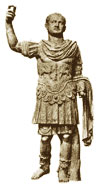 Titus
TitusThe name of this new amphitheatre was initialy the 'Flavian Amphitheater' in honor of Vespasian's ancestors. The name 'Colosseo', apparently derived from a nearby bronze statue of Nero that was defined as 'colossal', was later given at some time in the medieval ages. Vespasian died a year before the completion of the coliseum but it was nevertheless officially inaugurated in 80 A.D. by Titus, one of his sons.
 Domitian
A few years later, Domitian (the youngest of Vespasian's son) became Emperor and he expanded the coliseum's construction by increasing its crowd capacity at the third level. He also commissioned the development of an underground network, also called 'hypogeum', of tunnels and cells to contain slaves and wild animals.
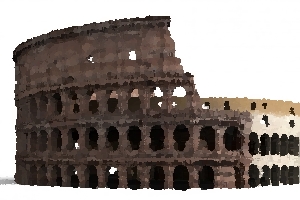 A 3d representation of the Roman Coliseum. [CC] credit.
The Coliseum was used as a 'sport' and drama amphitheater for about 500 years. Over these years, the coliseum had to receive major repairs, especially after a lightning-caused fire in 217 A.D. Even after the fall of Rome in 476 A.D., although there were no more gladiator fights, it was still used for spectacle kind of events like animal hunting and drama for almost a century. It then eventually lost its initial entertainment vocation to serve as housing in the early medieval ages. It was even used as a castle at some point by a very influential Roman family (Frangipani).
 Pope Benedict XIV
After the great roman earthquake of 1349 A.D., which left large damages on the coliseum, a religious community used the old amphitheatre as a home up until the early 1800's. In the mid 18th century, Pope Benedict XIV declared the coliseum 'sacred' because of the Christian martyrs that apparently perished in the arena in its earlier history.
Since the 19th century, significant restorations of the coliseum and excavation of its underground network and it became one of the world's top sightseeing attraction.
Architecture
 The interior architecture of the Coliseum in Rome. [Report image]
The colosseum was built to contain 50,000 spectators, which is a monumental feat at that time, considering it could still be considered huge by modern standards. The arena floor is all made of wood underneath which there is a myriad of tunnels and passageways for spectacle staging and wild beasts roaming. The construction was made of a carefully chosen combination of concrete and travertine for the foundations, piers, and beautiful arcades.
The Roman Coliseum today
It is now visited every year by millions of tourists. Major work has also been done in the past decades to counter the effect of stone degradation.
The coliseum also stands today as a symbol against the death penalty and capital punishment. Although the brutality of the spectacles presented in the colosseum was to put man's so call dignity to shame, its history sparkled people's imagination for generations. Gladiator fights, human fed to hungry beasts, and violent sporting events have nothing the human race can be proud of. However, its architectural magnificence will always make the colosseum one of the greatest historical monuments of Rome.
 A view from the inside looking towards the coliseum areana floor (field). [Report image]
The roman colosseum is definitely a 'must-see' in Rome as a testimony to its history and achievements by ancient Romans.