

Galleria Principe di Napoli
Last updated on September 30, 2026Why visit Galleria Principe di Napoli
Galleria Principe di Napoli is a rare covered passage whose incomplete plan explains the street around it: three arms survive because Santa Maria di Costantinopoli prevented the fourth. Its three exits climb different stair lengths, making the ground itself part of the architecture here.
Visit if you:
- want to compare Naples’ two nineteenth-century iron-and-glass galleries
- are interested in how a building negotiates a sloping historic site
- are already walking between the archaeological museum and Piazza Dante
- prefer urban fabric to a polished shopping interior
Skip it if you:
- expect a busy shopping mall with a complete cross-shaped plan
- need a fully level route; the three approaches have different stair lengths
Quick facts
- Type: Building, Shopping Mall
- Local name: Galleria Principe di Napoli (vedi la pagina italiana)
- Visitor access: Partial access
- Reservation: Not required — tickets on the door
- Built: 1873–1883
- Built for: Covered public passage and commercial gallery in the Fosse del Grano redevelopment
- Designed by: Nicola Breglia and Giovanni De Novellis
- Architectural style: Masonry gallery with iron-and-glass roof, modelled on Parisian passages
- Arms: Three completed arms
- Restoration: Major conservation works in 1969
Visit responsibly
The gallery is also a route for people working in the surrounding offices and institutions. Pause at the side of the passage, keep the stairs clear, and do not turn the museum-facing portico into a photo queue.
The 1965 collapse and 1969 restoration show how vulnerable neglected masonry and decorative surfaces can be. Do not lean on balustrades, climb portals or touch damaged-looking finishes.
Most of the block is mixed-use rather than a visitor facility. Keep voices and photography away from office and residential entrances, and spend with any independent businesses that are actually open rather than expecting every doorway to be a shop.
Where it is

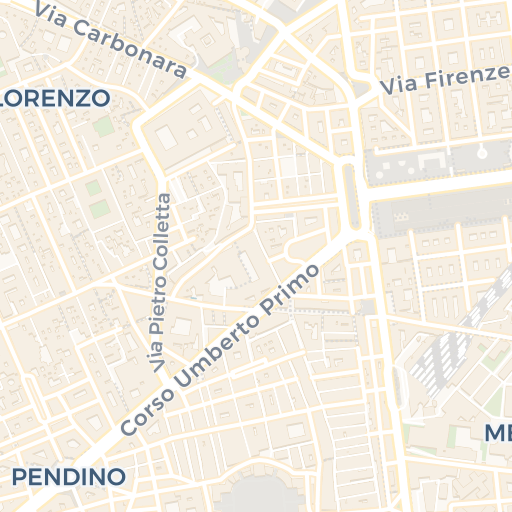
Get directions Open in Apple Maps
© OpenStreetMap contributors · © CARTO · 40.85245, 14.25031
Plan your visit
Best viewpoint: The museum-facing portico and the interior junction where the three arms meet
Access. Galleria Principe is a historic commercial passage beside the Accademia di Belle Arti and National Archaeological Museum, but the current official record reviewed here does not publish a dependable daily access notice. The Comune tender portal records a first-lot executive restoration project for the internal façades, paving and porticoes; it does not state which parts are usable on a given day. Check locally rather than relying on the gallery as a continuous shortcut.
The three approaches have staircases of different lengths because they meet streets at different elevations. Visitors who need step-free movement should plan the surrounding route in advance. Shops, offices and events may have their own access, and the archaeological museum beside the gallery has separate admission and hours.
Verified against Comune di Napoli, September 2026.
When to visit
April to June and September to October are the easiest months for combining the gallery with the museum and the historic centre on foot. Summer brings stronger heat and more visitors around Piazza Museo; winter is quieter, though the passage is most useful as a short sheltered link rather than a destination with a seasonal programme. Go in daylight, when the roof and three-arm geometry are easiest to read. No reliable attraction-specific calendar is published, so confirm any event or tenant hours locally.