

Palazzo della Civiltà Italiana
Last updated on October 6, 2026Why visit Palazzo della Civiltà Italiana
The draw
It is the most photographed building in Rome that nobody can go into. The "Colosseo Quadrato" takes the Colosseum's tight sequence of arches and repeats it 216 times across four identical elevations — which is why it reads as a single idea rather than a facade.
The inscription is still up there and still legible. "Un popolo di poeti di artisti di eroi di santi di pensatori di scienziati di navigatori di trasmigratori", running round the summit, written for a building meant to hold the Mostra della Civiltà Italiana and then become a permanent museum of Italian civilisation.
And the cinema has used it for eighty years. With its rational and metaphysical architecture it has been the background or a quotation in many films, from Rossellini's Roma città aperta to Antonioni's L'Eclisse, from Fellini's Otto e mezzo to Peter Greenaway's The Belly of an Architect, to Brizzi's Notte prima degli esami.
The friction
- You cannot go in. The building holds the Direction and the offices of Fendi and is open to the public only on the occasion of events and exhibitions.
- No hours and no price are published, because there is no ordinary opening.
- It is out at the EUR, a metro ride from the centre and nothing like it in character.
- It is not what it was designed to be. The exhibition it was built for never took place.
The tactic
Treat the outside as the visit, because it is. Free, permanent, and with four identical elevations there is no wrong approach — stand far enough back to read the inscription and the whole idea is in front of you.
Count a column of arches and multiply. 216 across four faces is six rows of nine on each — the sort of fact that makes a building legible in a glance.
Look at the ground floor, not only the grid. Under the arcades of the first order stand 28 marble statues representing arts and human activities, and at the sides of the two opposed staircases are the four sculptural groups of the Dioscuri by Morbiducci and Felci.
Read the material against the intention. The authors designed it in masonry; it was built in reinforced concrete and faced with slabs of travertine for reasons of economy and time. The travertine is a skin.
Watch for an exhibition. That is the only published route inside, and it is occasional.
Skip it if you:
- Expect to get inside. Only events and exhibitions open it.
- Are short of time in the centre. The EUR is a deliberate trip.
- Have no interest in twentieth-century architecture. That is the entire subject.
Quick facts
- Type: Modern Architecture, Building, Monument, Historic Place
- Local name: Palazzo della Civiltà Italiana (vedi la pagina italiana)
- Built: Designed <time datetime="1937">1937</time>, begun <time datetime="1938">1938</time>, interrupted <time datetime="1943">1943</time>, finished after the war
- Built by: Giovanni Guerrini, Ernesto La Padula and Mario Romano
- Built for: The Mostra della Civiltà Italiana at the Universal Exposition of 1942
- Architectural style: Italian rationalism — reinforced concrete faced with travertine, 216 arches on four identical elevations
- 216 arches, four identical faces: The arch taken from the Colosseum is repeated 216 times across the four equal elevations — hence the Square Colosseum.
- It is Fendi's head office: The building holds the Direction and offices of the Maison Fendi, and opens to the public only for events and exhibitions.
Visit responsibly
People work here. The Palazzo holds the Direction and the offices of Fendi; the doors at the top of the staircases are a company's entrance, not a visitor route.
Read the inscription as a document. "Un popolo di poeti di artisti di eroi di santi di pensatori di scienziati di navigatori di trasmigratori" was written for the Mostra della Civiltà Italiana at a 1942 exposition staged by the regime that built the EUR. It is the building's own statement of purpose, and it is worth reading as one.
The quarter is the context. The building went up within the great urban intervention that led to the building of the EUR quarter; it was designed as its centrepiece and reads differently when you have walked the rest.
The travertine is a facing, not a structure. The slabs clad a reinforced concrete frame adopted for reasons of economy and time — the surface is thinner than it looks.
The sculpture is at hand height. The 28 marble statues stand in the openings of the first-order arcade, within reach from the platform.
Where it is
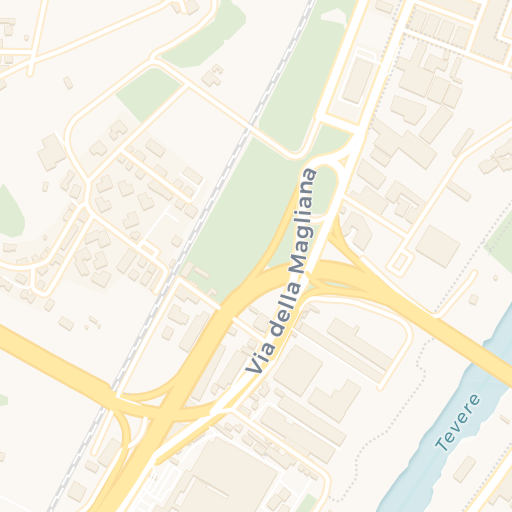
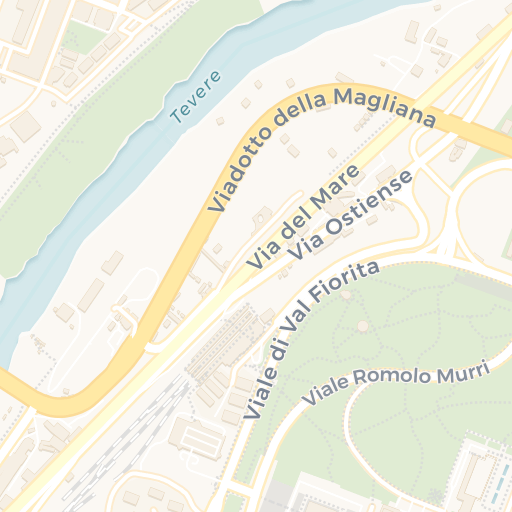
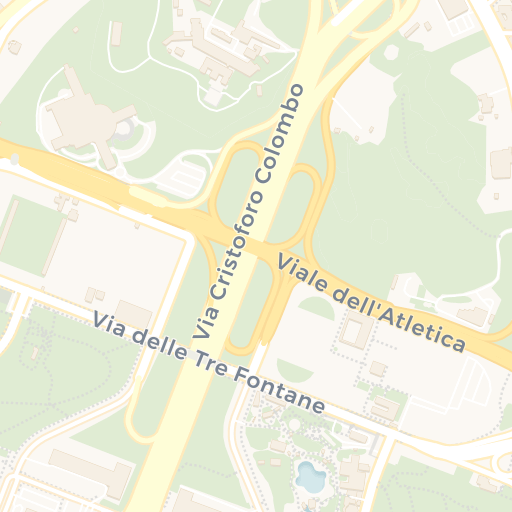
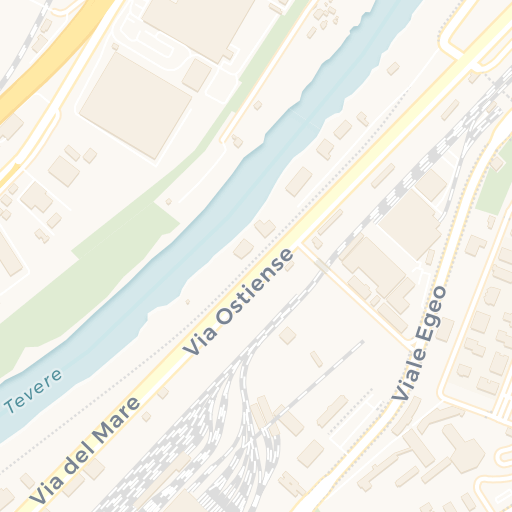
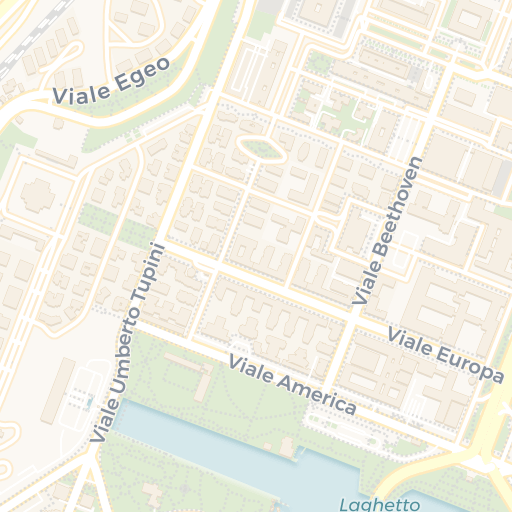
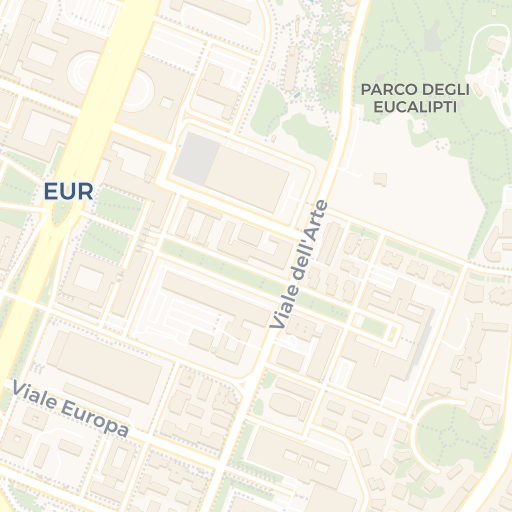
Get directions Open in Apple Maps
© OpenStreetMap contributors · © CARTO · 41.8367, 12.4653
Plan your visit
You cannot ordinarily go in — it is an office
Turismo Roma states that the Palazzo houses the headquarters of the Maison Fendi, that it holds the Direction and the offices of Fendi, and that it is open to the public on the occasion of events and exhibitions. There are no opening hours and no admission price, because there is no ordinary opening.
The outside is free, permanent and complete
The building stands at the Quadrato della Concordia in the EUR. Because the four elevations are identical, there is no wrong side: the 216 arches, the inscription at the summit, the Dioscuri at the staircases and the 28 statues under the first-order arcades can all be read from the ground, from any direction, at any hour.
What you are looking at
- 216 arches across four identical elevations — the Colosseum quotation that gave it the name "Colosseo Quadrato".
- Reinforced concrete faced with travertine, though the architects designed it in masonry.
- Four Dioscuri groups by Morbiducci and Felci, and 28 marble statues of arts and human activities.
- The inscription for a museum of Italian civilisation that never opened.
Ticket & Pass Decision Matrix
| Option | Cost | What it gets you | Booking | Verdict |
|---|---|---|---|---|
| Seeing it from outside | Free | All 216 arches, the inscription, the Dioscuri, the 28 statues | None | The visit. Four identical faces means nothing is hidden from you. |
| An event or exhibition | Not published | The interior, on that event's terms | Per event | The only published way in, and occasional. |
| Turning up hoping to enter | — | Nothing. It is Fendi's Direction and offices. | — | Do not plan the trip around getting inside. |
| Low sun | Free | The arches reading as deep black voids against white travertine | None | The one variable that changes the building. |
Verified against Turismo Roma, October 2026.
When to visit
Any hour of any day, for the outside. There is nothing to open: the exterior is free, permanent, and the four identical elevations mean there is no best side to arrive on.
Low sun, for the arches. The facade works by shadow — 216 openings cut through flat travertine — and strong raking light turns it into black and white. Flat cloud flattens it completely.
After dark, for the lit version. The EUR is built around this building, and it is the thing the quarter lights.
When an exhibition is on, if you want inside. That is the only published access: open to the public on the occasion of events and exhibitions.
Allow half an hour. It is one building, seen from outside — but the inscription, the Dioscuri and the 28 statues under the arcades take longer to find than the grid suggests.