Skip to content

Keep a little mystery in your trip planning: Explorer Picture Mode shows a stylized version of every place instead of the real photo, so you can go by the description and reviews first and picture it your own way -- reveal the real photo any time by flipping the switch off, or just for one place at a time from its own page.

Create a free account to pick your own style (Vintage, Oil Painting, Black & White) and have it remembered next time you visit.

Great Pyramids of Egypt

/10

Architecture

Changed

The largest pyramids are built from millions of individually cut stone blocks, an achievement that remains genuinely impressive given the tools and techniques available in the Bronze Age. Each pyramid was precisely aligned so its four sides face true north, south, east, and west -- an accuracy that reflects both careful surveying and the solar-based religious beliefs that shaped the pyramids' design.

The largest pyramids were originally faced with polished white limestone casing stones, with the capstones likely gilded -- a finish that made them sun-reflective and considerably more striking than the exposed stone visible today, since most of that outer casing was later stripped for reuse elsewhere. Most pyramids also contain intricate internal passages and burial chambers reaching deep into the structure.

Site plan

Site Plan and Features

Changed

The Great Pyramid of Khufu

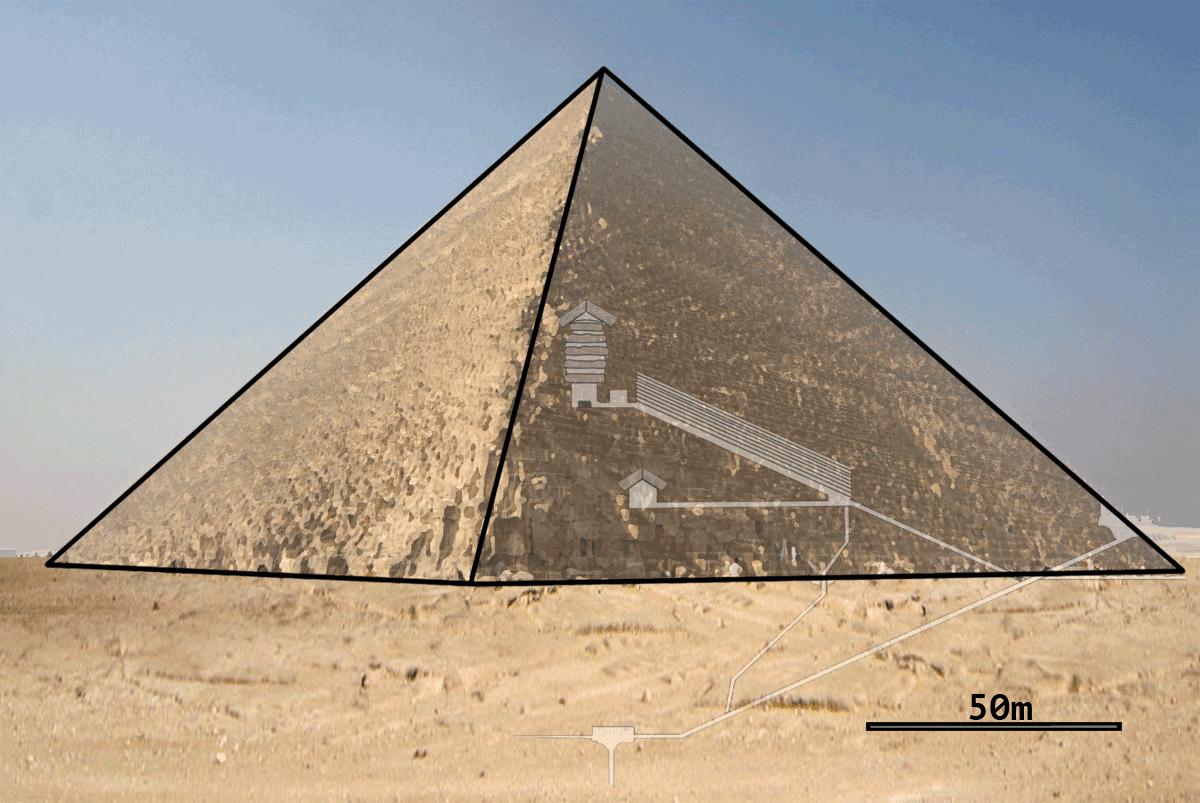
Khufu Pyramid Interior
The interior tunnels and chambers of the Khufu Pyramid. [Report image]

The Great Pyramid of Khufu (or Cheops) is the last standing monument of the ancient Seven Wonders of the World. More than two million individually cut stone blocks went into its construction, and an interior passageway leads to a royal burial chamber inside.

The Great Sphinx

The Sphinx and Giza Pyramid
The Sphinx in front of the great Khafre Pyramid. [Report image]

The Great Sphinx is roughly the size of a five-story building (73 by 21 meters, or 241 by 69 feet) and sits aligned with the pyramid of Khafre within the wider archaeological complex.

The monument combines a lion's body with a human face, generally believed to depict either Khafre or Khufu -- a reversal of the usual convention in Egyptian art, where gods were typically shown with an animal head atop a human body, making the Sphinx symbolically distinct as well as physically massive.

Landscape

Changed

The pyramids sit on the Giza Plateau, a limestone escarpment on the edge of the Sahara just outside modern Cairo -- close enough to the city today that its outskirts are visible from the site, though the plateau itself was remote desert when the pyramids were built.

That limestone bedrock wasn't just a building site -- much of the pyramids' core stone was quarried directly from the plateau itself, with finer casing stone and granite for interior chambers brought from farther afield, including Aswan, hundreds of kilometers up the Nile.

The plateau sits at the edge of the Nile floodplain, whose annual flooding historically supported the agricultural surplus and organized labor force that made building on this scale possible in the first place.

Changed

Changed

Publishing will make these pending changes visible on the live page.