Keep a little mystery in your trip planning: Explorer Picture Mode shows a stylized version of every place instead of the real photo, so you can go by the description and reviews first and picture it your own way -- reveal the real photo any time by flipping the switch off, or just for one place at a time from its own page.
Create a free account to pick your own style (Vintage, Oil Painting, Black & White) and have it remembered next time you visit.
You can't quite fully experience the essence of Italy without visiting the unforgettably exhilarating, unique, and breathtaking city of Venice (Venezia). Venice, the capital of the region as well as the province of Veneto, in northeastern Italy, is the beautiful "Queen of the Adriatic," with a population of close to 262,000.
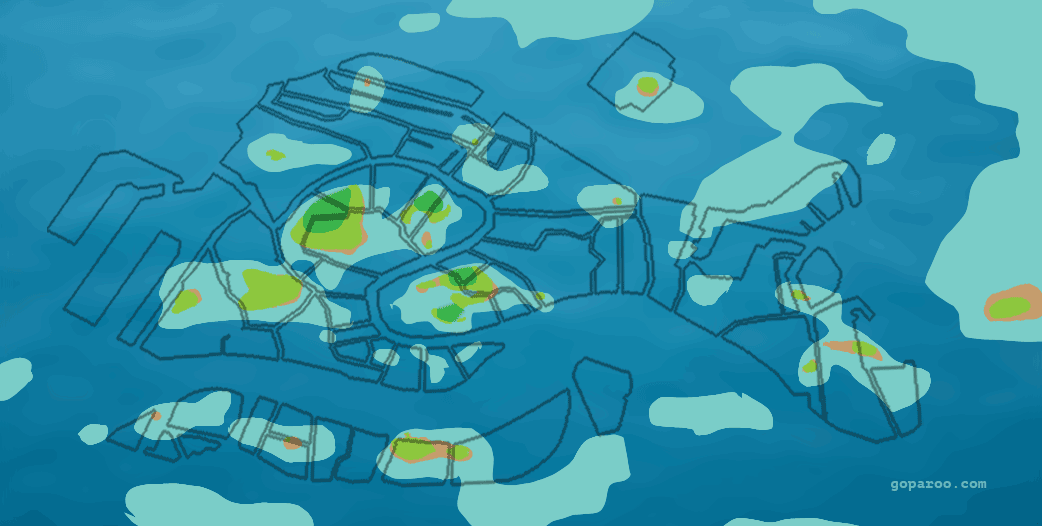
Venice stretches across a group of islands in the marshy, shallow, saltwater Venetian Lagoon alongside the Adriatic Sea, between the mouths of the Piave River to the north and the Po River to the south. A map of the initial Venetian lagoon before the construction of Venice that is made of tiny islands. The current and larger city is outlined in black on top. [Report image]
Legend says Roman refugees founded the city in 422, though the fuller story is closer to what History (below) describes: a gradual settlement of the lagoon by people fleeing invasion on the mainland. From an obscure lagoon outpost, Venice grew over the following centuries into the Most Serene Republic, a major sea power, trading empire, and center of art and culture that lasted, in one form or another, until Napoleon conquered it in 1797.
The city of Venice today
Today, Venice is best known for its canals, built across 118 islands connected by roughly 150 canals and 400 bridges. Nobody drives anything besides a boat here -- transportation is strictly on water or foot, making Venice the largest fully functioning, self-sustaining automobile-free urban center in Europe. A typical Venice canal. [Report image]Locals get around via motorized water buses and private boats for everyday use, while gondolas are reserved mostly for tourists and special occasions.
Is Venice sinking?
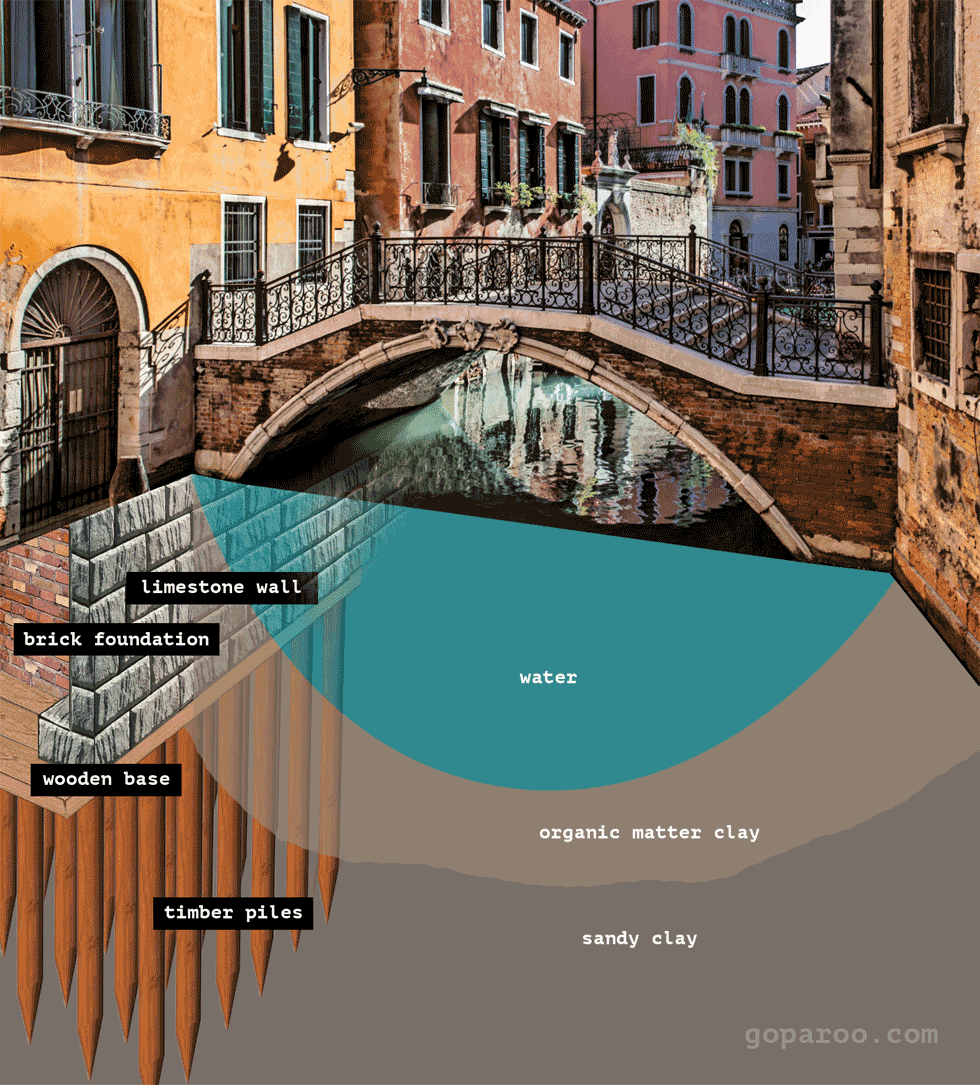
Venice's buildings stand on wood piles driven deep into the lagoon's mud and sand (wood doesn't decay underwater), a foundation that's kept the city standing for centuries. Beneath the water layers of a Venice canal and buildings. The layers are from bottom to top: timber piles planted in organic mater and sandy clay, a wooden base, a brick foundation and a limestone wall. [Report image]Whether Venice is actually sinking, whether sea levels are rising, or both, has long been disputed -- what's clear is that the use of artesian wells in the 20th century accelerated the problem badly enough that they were banned in the 1960s. The city still faces regular flood tides today, and some experts have proposed pumping water into the underground soil to lift Venice back up as a more permanent fix.
Landmark attractions
Venice offers a wealth of tourist attractions beyond the surrounding beauty of the islands and the lagoon itself -- see Attractions below for the full list, including the city's grand piazzas, palaces, churches, and bridges.
Venice also faces real problems with overtourism, drawing crowds each year on a scale closer to London or Paris despite being a much smaller city. A large cruise ship in the Grand Canal of Venice. - By VladoZgSee Responsible Travel Advice below for how to visit thoughtfully.
How to Experience Venice
Changed
Geography
Changed
Climate Patterns
Changed
Attractions Intro
Changed
Venice is a place of never-ending wonder, and there's a lot more to the "floating city" than its majestic canals. Its landmark sights include the grand Piazza San Marco and Campo San Polo; palaces like the Doge's Palace, Palazzo Grassi, and Palazzo Labia (plus the Peggy Guggenheim Collection); churches including the Basilica di San Marco and the Basilica di Santa Maria della Salute; and famous bridges like the Rialto Bridge, the Bridge of Sighs, and the Scalzi Bridge. The Accademia gallery, the Arsenal, and La Fenice opera house round out a list that could easily fill a week.
Here is a list of the best tourist attractions in Venice. It also includes an extensive list of palazzos (palaces) that you can admire when floating through the waterways.
History
Changed
The history of Venice has always been closely associated with the sea. Today the city -- at one time the world's greatest trading empire -- still fights a constant battle with the sea as well as the crowds of visitors it receives.
Venice has had a long and often turbulent history. There was a settlement in the area as far back as 2000 years ago -- archaeological evidence indicates hunters and fishermen settled on the banks of the lagoon. During the 5th century, the ravages of the notorious Attila the Hun caused many more people to seek refuge in the area.
During its early days, the city was ruled by Byzantium (now known as Istanbul) but in 726, the city decided to elect its first Doge, or duke. The spectacular Doge's Palace was built between 1309 and 1424. From the 9th century onwards, the city experienced a steady increase in population -- along with more demand for space to build on.
To ensure a stable foundation, people in the area began to build on wooden pilings driven deep into the mud of the lagoon. Today, many buildings in Venice still stand on those same pilings and the layout of modern Venice still reflects that initial "building boom".
By the end of the 10th century, Venice had become a rich and powerful trading state. Treasures poured into the city from all four corners of the world -- from the sacking of Byzantium, from the crusades in the Middle East and from the once powerful Roman Empire.
The gondola -- the enduring symbol of the city -- made its first appearance during the 11th century. The gondola was first designed to be a means of transport for rich people and its distinctive flat bottomed design was so that it could easily be navigated through the many sandbanks.
Today, there are just a handful of traditional gondola builders left in Venice and the design has changed little over the years. Gondola licenses are passed down from one generation to another. The most picturesque gondola workshop can be found in the working-class Accademia neighborhood.
Venice's famous carnival dates back to the year 1162, when the city slaughtered a dozen pigs to celebrate victories in battle. Over the years, the celebration grew and carnival masks were first worn in 1268. Masks were worn for various reasons, one of which was to hide the social order of the wearer. Today, the carnival attracts revelers from all over the world and carnival masks have become a well known symbol of the city.
The city's fortunes changed again during the early 16th century when Venice found itself at war not only with the Papacy, but with several European powers as well, including Spain. Gradually, the once powerful trading city began to slide into bankruptcy as the Netherlands and England became the dominant trading powers.
By the beginning of the 19th century, the beautiful city of Venice was in a sad state of decay. The city was saved by tourists who discovered the city -- and haven't stopped coming since.
The area of Venice known as the Lido was transformed into a fashionable seaside resort and Venice became a required stop on the "Grand Tour" -- a sort of cultural experience for British men. And the city became even better known with the publication of Thomas Mann's novel "Death in Venice".
In the 1960s Venice was hit by a series of devastating floods which helped to increase efforts to permanently protect the city from the elements. Today, the city still experiences regular floods depending on the tide and the winds. Efforts have been made to prevent flooding by dredging some of the shallower canals and raising the level of some of the streets.
Venice's fortunes have shifted again in recent decades: the same tourism that saved the city in the 19th century now threatens to overwhelm it, drawing as many visitors each year as cities many times its size -- see Responsible Travel Advice for how the city is responding today.